Q1. Why do animals like frogs and fish lay hundreds of eggs?
Solution
Animals like frogs and fish lay hundreds of eggs and release millions of sperms. But the entire eggs do not get fertilized and develop into new individuals. This is because the eggs and sperms get exposed to water movement, wind and rainfall. Also, there are other animals in the pond which may feed on eggs. Thus, production of large number of eggs and sperms is necessary to ensure fertilization of at least a few of them.
Q2. Mention any two functions of human ovary.
Solution
(i) It produces female gametes called ovum.
(ii) It secretes female sex hormones.
Q3. What is the main function of fallopian tubes?
Solution
The fallopian tubes act as a site for the fertilization of egg and sperm.
Q4. What is internal fertilization? Name any two animals in which this fertilization occurs.
Solution
Fertilization which takes place inside the female body is called internal fertilization. Internal fertilization occurs in animals such as humans, cows, dogs and hens. (Any 2)
Q5. List the stages in the lifecycle of frog.
Solution
The lifecycle of a frog has three distinct
stages—egg, tadpole or larva and adult frog.
Q6. Differentiate between foetus and embryo.
Solution
Foetus
Embryo
1. Developing structure of the embryo
1. Developing structure of the zygote
2. Undergoes drastic change
2. Undergoes slow change as cell divides many times
Q7. Diagrammatically show the process of fertilisation.
Solution

Q8. What is the importance
of reproduction?
Solution
Reproduction is essential
for the continuation of a species, generation after generation.
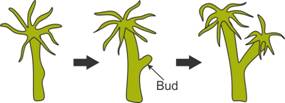
Q9. Draw a neat labelled diagram of budding in
Hydra.
Solution
Q10. Which organ of female reproductive system is also known as 'birth canal'?
Solution
Vagina is also known as 'birth canal'.
Q11. Write a short note on human sperm.
Solution
Sperm is the male gamete produced by testes. It is a single cell with all the usual cell components. It is very small in size. Each sperm has a head, a middle piece and a tail.
Q12. Discuss the development of chick from zygote.
Solution
Soon after internal fertilization in hen, the zygote divides repeatedly and travels down the oviduct. As it travels down, many protective layers are formed around it. The hard shell in a hen's egg is one such protective layer. After the hard shell is formed around the developing embryo, the hen finally lays the egg. The embryo takes about three weeks to develop into a chick. After the chick is completely developed it bursts open the egg shell.
Q13. Where does the embryo get embedded in the
female reproductive system? What is its function?
Solution
The embryo gets embedded in the wall of the
uterus. The uterus carries
out functions of protection,
nutritional support and waste removal for the developing foetus.
Q14. What do you mean by pregnancy?
Solution
Development of foetus that is carried within the uterus is called pregnancy
Q15. When is IVF done? Discuss how this process is carried out leading to birth of test tube babies.
Solution
In some women oviducts are blocked, due to which sperms cannot reach the egg for fertilization. Hence, these women are unable to bear babies. In such cases IVF is carried out. In this procedure, the doctors collect freshly released egg and sperms and keep them together for a few hours so that in vitro fertilization or fertilization outside the body occurs. In case fertilization occurs, the zygote is allowed to develop for about a week and then it is placed in the mother's uterus. Complete development takes place in the uterus and the baby is born like any other baby. Babies born through this technique are called test-tube babies.
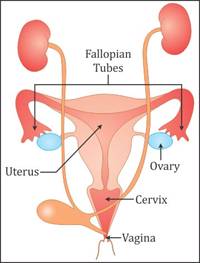
Q16. Draw a neat labelled diagram of the human
female reproductive system.
Solution
Q17. a)
How is zygote formed in sexual
reproduction?
b) Where
does development of baby take place in humans?
Solution
a) In sexual reproduction, the
fusion of male and female gametes produces zygote.
b) The development
of baby takes place in the uterus of females.
Q18. (a) Name two animals in which external fertilization occurs.(b) What do you mean by foetus?
Solution
(a) Frog, fish, starfish (Any two)(b) The stage of the embryo in which all the body parts can be identified is called a foetus.
Q19. Differentiate between sperm cell and egg
cell on the basis of motility and size.
Solution
Men release millions of sperm per
ejaculation and can repeat that several times per week, whereas women release
one ovum per menstrual period.
Egg cells are larger in size (varies from
0.15 to 0.2 mm) compared to sperm cells.
Q20. Describe
the functions of the following
1. Ovary
2.
Uterus
3.
Cowper’s Gland
4.
Placenta
5.
Testes
Solution
1. Ovary:
It produces female gametes ova.
2. Uterus:
It is site of development of embryo.
3. Cowper’s
Gland: Secretes a fluid which acts as a lubricant in semen.
4. Placenta:
Nourishes and supplies oxygen to the developing embryo.
5.
Testes: Produces male gametes called sperms.
Comments
Post a Comment