Q1. Name the first astronaut who landed on moon and when did he land on it.
Solution
On July 21, 1969 the American astronaut, Neil Armstrong, landed on the moon for the first time.
Q2. Do all the stars in the sky move? Explain.
Solution
No. The Earth rotates from West to East on its axis. Hence, all stars in the sky appear to move from East to West. With reference to the Earth, the Pole star does not appear to move in the sky because it is located above the axis of rotation of the Earth in the north direction. It appears to remain stationary at a point in the sky.
Q3. Which star is nearest to earth? What does it provides us?
Solution
The sun is the nearest star. It is the main source of heat and light for all the planets.
Q4. Why do the stars appear to us like point objects?
Solution
The stars are much bigger than the earth, yet they appear to us like point objects because they are millions of kilometres farther away from the earth.
Q5. What is a comet? How does it appear?
Solution
A comet is a member of solar system which revolves around the sun in highly elliptical orbits. It appears as bright head with a long tail.
Q6. Give two differences between stars and planets.
Solution
Differences between stars and planets:
1. A star has its own light but a planet has no light of its own. It shines by reflecting the light of the sun.
2. Stars twinkle at night, while planets do not twinkle.
Q7. Mention any three celestial objects in the sky.
Solution
The stars, the planets and the moon.
Q8. Why no life exists on moon?
Solution
No life exists on moon because there is no atmosphere and no water.
Q9. Name the brightest object in the night sky.
Solution
The moon is the brightest object in the night sky.
Q10. Why does the moon change its shape everyday?
Solution
The moon does not produce its own light so it is seen only when the sunlight reflects it. Therefore, we see only that part of the moon from which the light of the sun is reflected towards us.
Q11. Name the brightest star in the sky. Where is it located?
Solution
The star Sirius is the brightest star in the sky. It is located close to Orion.
Q12. What is a constellation? Name any two constellations.
Solution
A constellation is a group of stars that can be identified with the shape of an identifiable object like an animal or a known object.
The two well known constellations are Ursa Major and Orion.
Q13. Which constellation is called 'Saptarishi' and why it is so called?
Solution
Ursa Major is called as Saptarishi as it has seven prominent stars.
Q14. What is 'full moon day'?
Solution
The day on which the whole disc of the moon is visible is known as the full moon day.
Q15. What happen to meteors when it enters the earth’s atmosphere?
Solution
When meteors enters the earth’s atmosphere it starts glowing and are seen as a bright steak of light flashing momentarily across the sky.
Q16. Name the inner planets.
Solution
Mercury, Venus, Earth and Mars.
Q17. What is a meteorite? How does it help the scientists?
Solution
A meteor glows and evaporates quickly as it enters earth's atmosphere. Some meteors are large and so they can reach the earth before they evaporate completely. The body that reaches the earth is called a meteorite. Meteorites help the scientists in investigating the nature of the material from which the solar system was formed.
Q18. What happens to the size of the moon after the new moon day?
Solution
The size of the illuminated part of the moon visible from the earth increases each day after the new moon day.
Q19. Why the bright streak of light only lasts for a very short time?
Solution
A meteor enters the earth's atmosphere with a very speed. This creates the friction due to the atmosphere which heats it up. It glows and evaporates quickly. That is why the bright streak of light only lasts for a very short time.
Q20. Draw sketches to show the relative position of prominent stars in (a) Ursa Major and (b) Orion
Solution
(a) Ursa Major appears like a big dipper. There are three bright stars in the handle and four stars in the bowl of the dipper.
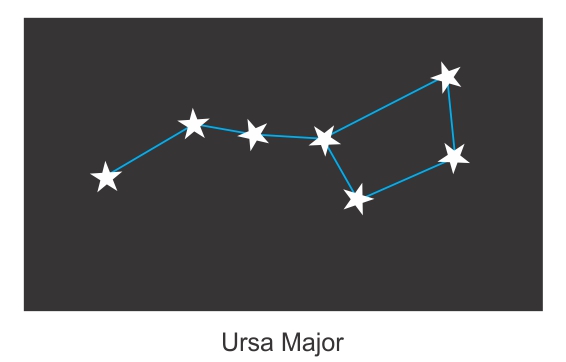 (b) Orion appears like a hunter. Three bright stars appear in the belt, while five bright stars are arranged in the form of a quadrilateral.
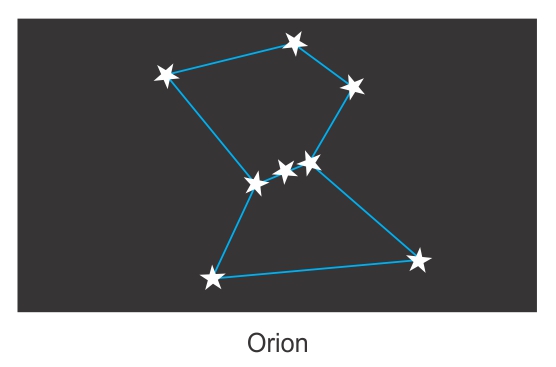
(b) Orion appears like a hunter. Three bright stars appear in the belt, while five bright stars are arranged in the form of a quadrilateral.
Q21. Name two objects other than planets which are members of the solar system.
Solution
(i) Asteroids
A collection of a large number of small objects, gases and dust revolve around the sun. They occupy a large gap between the orbits of Mars and Jupiter. However, these are not planets. These celestial objects are known as asteroids.
(ii) Meteors
Meteors are small celestial objects that are seen as bright streaks of light in the sky. They brunt out on entering the Earth’s atmosphere because of the heat produced by friction. This results in bright streaks in the sky. They are not planets.
Q22. How can we locate the brightest star in the sky?
Solution
To locate Sirius, imagine a straight line passing through the three middle stars of the Orion. Look along this line towards the east and this will lead us to the brightest star, Sirius.
Q23. (a) Which is the planet nearest to the Sun? Why is it difficult to observe it?
(b) Why no life exists on moon ?
Solution
(a) Mercury is the nearest planet to the Sun. It is difficult to observe it as most of the time it is hidden in the glare of the Sun.
(b) No life exists on moon because there is no atmosphere and no water.
Q24. Which two planets have asteroids between them?
Solution
Aasteroids are the rocks pieces that revolve around the sun between the orbit of Mars and Jupiter.
Q25. After how many years can we see Halley's comet? When was it seen the last time?
Solution
Halley's comet appears after nearly every 76 years. It was last seen in 1986.
Q26. Why the planet 'Venus' is called the morning or an evening star?
Solution
Venus appears in the eastern sky before sunrise and sometimes it appears in the western sky just after sunset so it is called as the morning or an evening star.
Q27. Which is the planet nearest to the Sun? Why is it difficult to observe it?
Solution
Mercury is the nearest planet to the sun. It is difficult to observe it as most of the time it is hidden in the glare of the sun.
Q28. Why do the stars appear to move from east to west?
Solution
The stars appear to move from east to west because the earth rotates on its axis from west to east.
Q29. Which constellation looks like a distorted letter W or M? When can we find it in the sky?
Solution
Cassiopeia looks like a distorted letter W or M. It appears in the northern sky during winter in the early part of the night.
Q30. Which star is situated in the direction of earth's axis? How can you identify it?
Solution
The pole star is situated in the direction of earth's axis. It can be identified easily as it does not appear to move.
Comments
Post a Comment